
Documenting P. Diddy’s Downfall
The 50 Cent Problem of Moral Credit

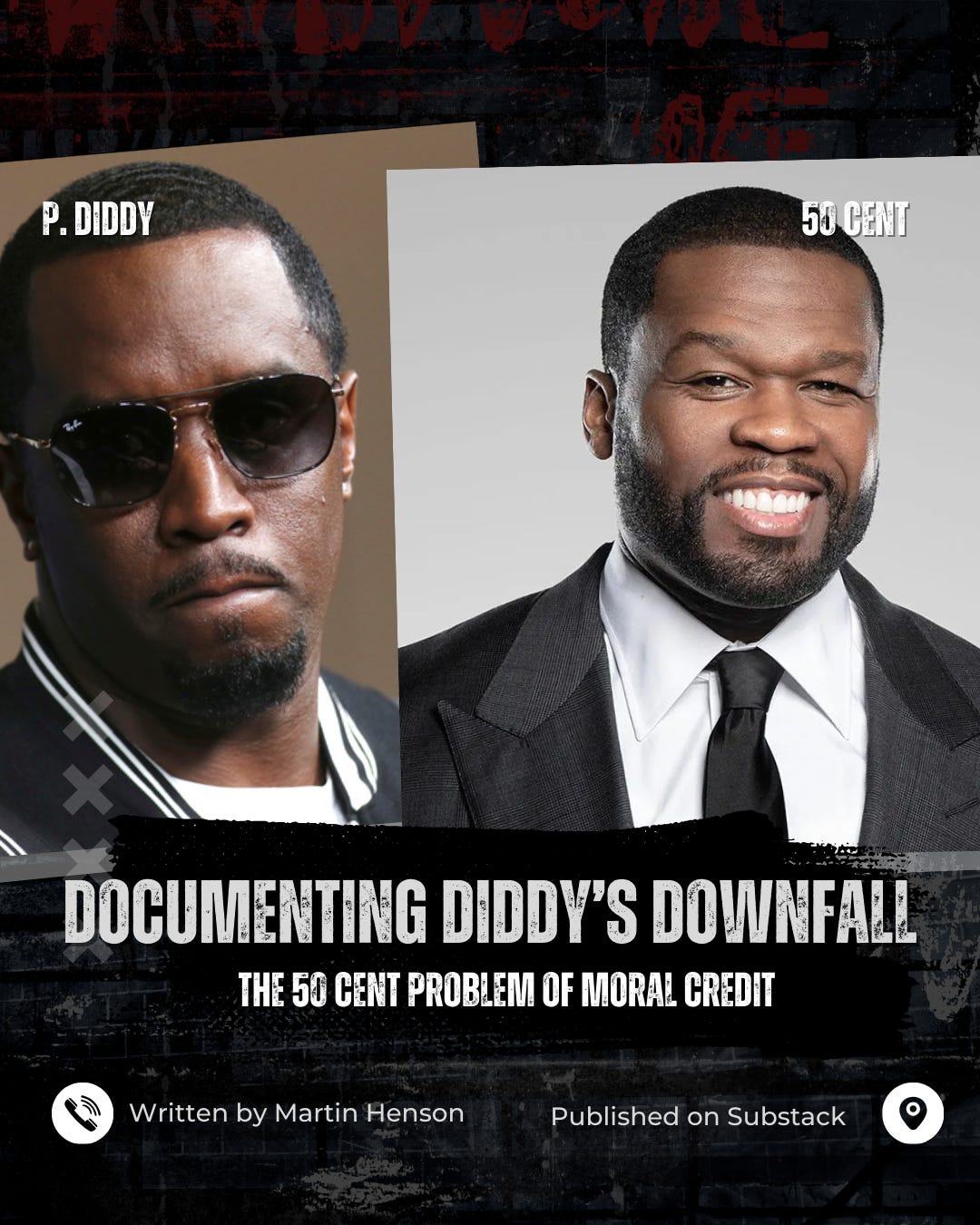
Sitting 10 feet away, mid-meal in a Midwestern McDonald’s, a person sat buzzing with anxiety, realizing they were looking directly at Luigi Mangione, the alleged fugitive responsible for the death of a United Health CEO. A cash reward was promised to the person providing information to the FBI tip line, not unlike the opportunity that the rapper 50 Cent received, when an unpaid videography tab left footage from a Sean Combs, aka P. Diddy, autobiographical sketch in his hands, or rather, the hands of 50’s production company. Whether the act of following through was good, in both occasions, seemed to depend less on what it produced, and more on how it was received. Both were complicated. Now, P. Diddy, a federally convicted billionaire accused of sex crimes, saw his last documented intimate moments, woven into a successful, widely viewed documentary produced by his rival 50 Cent.
P. Diddy, aka Sean Combs, aka Puff Daddy, was a global socialite whose downfall began after his long-time girlfriend, Cassie Ventura, brought a civil suit against him detailing a wide variety of violence. The cat was out of the bag as federal charges and, over 100 claims of sexual violence against him followed. Not only did this culminate in his arrests, but also a series of documentaries detailing his violence, seven at this point. Six documentaries came, all without the accompanying celebrity condemnation that came alongside the downfall of Cosby, Weinstein, and R. Kelly. Then came Netflix’s 4 Part Documentary produced by 50 Cent called Sean Combs: The Reckoning.
50 Cent, another rapper turned mogul who also goes by Curtis Jackson, capitalized on the opportunity to fill the silence. A notorious troll, equal parts savvy and petty, he leveraged his perennial antagonism for P. Diddy into a documentary expose. A good thing is a good thing, that is, unless you yourself are not considered good. Questions abound, unrelated to the documentary, interestingly turned towards 50 Cent: Is 50 Cent good enough for society to take the production seriously?
Time and time again, black men are judged by the harm that they have done, which is seen as more descriptive of their general character. So any goodness produced in light of this harm that has existed before has to be re-qualified or re-quantified into some level of deviance. 50 Cent has his own history of problematic behavior that pales in comparison to the charges against P.Diddy, but problematic nonetheless. A rose planted by a thief or a liar, still smells just as sweet, but in this case we must continually evaluate who planted it before society reaps the benefits of its presence.
It is not unreasonable to be curious about 50 Cent’s intentions, but context reveals a bit more. Since P. Diddy’s incarceration, Hollywood has been incredibly quiet about the charges.
“Freakoffs” were detailed as a feature of the sex trafficking allegations made against P. Diddy involving non-consensual sex, and tended to align with the massive celebrity parties Diddy threw over the last 20 years. 50 Cent never had to navigate complicity in these sex parties, because he never went. The #MeToo era’s shield for sexual victims is gone. When victims of P. Diddy came forward, there was no “black dress” Golden Globes protest of sexual violence. The NAACP has said nothing. In a world of complicity and “wait and see” legalese, all we have is 50 Cent.
Given long-standing allegations of violence against those who threatened P. Diddy’s power, 50 Cent’s stance carried risk. Yet, instead of catching the allure of this moment, society obsesses over the value of the man who receives credit, existing as a racialized obsession that never seems to pass the brown paper bag test.
Goodness, in this framework, is a performance that is inconsistently appraised. So, for 50 Cent to come out with a documentary that highlights the terrible behavior of P. Diddy, society meets people who are unable to align a valuable act of calling out with the fundamental positive benefits of the act. This sort of call-out culture struggles to understand the positive behavior of people who have been previously labeled terrible, or people who don’t quite fit the binaries of good and evil or bad and good. Much like reporting a fugitive for a reward may feel appealing to an underpaid worker, despite a lack of empathy from an observing audience. This effort works to contain the moral meaning of producing the documentary, so that 50 Cent is not allowed to gain moral legitimacy.
Seeing the act itself as good, risks 50 Cent surpassing the categorical role prescribed to him. In this way, 50 Cent can never “become” good, because allowing his presence will disrupt existing hierarchies of value. The effort to ensure that he is always a two-dimensional gangster producer is the same one that keeps the world from understanding the documentary’s social and cultural utility.
So 50 Cent’s desire to tell a story about the nature of corruption is reframed away from a historically nuanced view of victimization, and towards one that frames him as someone fundamentally invested in the downfall of another character for selfish reasons. This nature of re-ascribing people says something about our beliefs in human nature. It shows that our society believes that people should be defined and understood by the level of harm or violence they’ve previously engaged in, regardless of the effort they’re making now or its benefit. We believe that this effort supersedes the value of the acts utility, and that society’s view of an individual is absolute, rendering them unable to change.
We tell children all the time that if they’re good, then they can be forgiven, but the moment they become adults, they must be known by all the sins they have committed prior. People become confined to assigned categories, categories that limit the behaviors we encourage in others. Ultimately, these categories uphold the psychological logic that makes punishment feel inevitable.
Consider the impact of documentaries. After the Surviving R.Kelly: the final chapter, RAINN saw a 50% increase in calls to their sexual assault hotline. After The Hunting Ground, Australia published its first national student survey on sexual assault. After Audrey and Daisey, SafeBae was founded, training over 2,100 youth as certified peer educators in 2025. Sean Combs: the Reckoning will join this list of documentaries that have produced a public good.
The nihilism that we have towards goodness mandates that people must align with our ideological set, but in reality, people do good things for a variety of reasons. Focusing on the act itself makes goodness a matter of behavior rather than social evaluation.
This generation is invested in excavating motivations and ideologies before something can be declared good. A good act carries its own inherent value, no matter who does it or for what reason. It is still good. And so when we tell children that they can move past their worst day, and we tell people that you are not the summation of the things that you have done wrong, then we must allow good things to exist in ways that surprise us.
50 Cent may have motivations. He may hate P. Diddy. That doesn’t make what he did wrong. The opportunity to reap the benefits of good events will be lost when society focuses on who plants the seed. The world is a better place when we can accept a good thing as good based on what it produces. And Netflix’s Sean Combs: The Reckoning was a good thing.
I’m Martin Henson, writer, activist, and public speaker
Website: https://linktr.ee/martinhspeaks | Follow: Bluesky | Support: Buy me a Coffee]
✊🏾 Let’s build together.